Lowest fare
The coach day
Hot spring, village, temples
- Fromfrom $33
- Entry ticketsNot itemised in the record
- CancelFree up to 24 hours
Checklist you can tick
Chiang Rai temples day from Chiang Mai
★ 4.8 · 7,712 reviews so far
Checklist: 11 items
Mark each item when done. Progress is stored on this device.
0 / 11 ready
That is everything. Pick your date and your pickup point, and the temples are settled.
Reserve a spotTwo sources give two entry figures, and the temple is stricter about clothes than most. Here is what each one says, what a coach day does and does not settle, and how to arrive ready.
Editorial team, chiangraidaytour.click · Updated November 16, 2026 · ~8 min read
Summary view
Two sources give two numbers, and it helps to see both before you budget. The Tourism Authority of Thailand's attraction page for Wat Rong Khun lists an entrance fee of 100 baht.1 One day tour that starts in Chiang Rai lists optional cash payments by site, with THB 200 beside the White Temple. The page is the national tourist office's; the listing is an operator's checklist for its own guests.
Neither source says why the figures differ, so this guide does not guess. A tourist-office entry can lag behind the gate, and an operator's list can include a margin or a newer rate, but both are only possibilities. The safe reading is practical: expect a fee at the ticket window, carry the higher of the two figures in small notes, and count the lower one as a bonus.
Whatever the number, you pay it in baht and in person. The listing that names the fee says to carry cash for it, so do not count on a card machine at a temple gate. If the figure matters to your budget, the temple's own ticket window is the final word on the day, and it is worth keeping a small reserve in your wallet for the rest of the sights on a long trip. Write the gate cost into the plan before the trip, so that nothing about the day surprises you at the ticket window.
Two sources
| Place | Tourist office page | One listing's cash list |
|---|---|---|
| White Temple | 100 baht, 08.00 to 17.001 | THB 200 |
| Black House | 09.00 to 17.00, group visits notified12 | THB 80 |
| Opium House | 50 Baht, 7.00 to 19.0013 | THB 50 |
| Blue Temple | 07.00 to 20.00, no fee given14 | No fee named |
| Hilltop temple | 40 baht, 07.00 to 21.0015 | No fee named |
The tourist office figures are the dated ones on its attraction pages and can change; the right column follows a single operator's list and covers only the sights on that day.
The attraction page has the gate open daily from 08.00 until 17.00 hrs, and the closing time is firm.1 A coach day that leaves Chiang Mai early reaches the gate in the middle of that window, and a private car can aim for the first or the last hour. After the hours end, the compound is closed, so it is not a place for an evening wander.
Crowds follow the tour buses. Tourist-office figures put the crowd at about 10,000 people a day.10 Midday brings the coach days, so the calmer slots are likely to sit at the edges: the first after opening and the last before the gate shuts. A small-group van that starts in Chiang Rai can reach those edges more easily than a coach from Chiang Mai.
Light is the other reason to pick your slot. White plaster and mirror glass look their hardest at noon and softer when the sun is lower. The tourist office's winter guide shows the temple at its most striking under a clear cool-season sky.11 If photographs matter to you, ask the operator which hour the group reaches the gate, and book a departure that gets you there before the buses stack up.
Cash on the day
These are the optional cash fees named in one operator's checklist for its own guests, not a price list from the sights; the tourist office lists 100 baht for the White Temple, so confirm at the gate.1
It depends on the booking, and the records are not uniform. At $33 the coach day is the cheapest listed here, and its record leaves entry tickets unitemised. That is not a promise that tickets are covered or that they are not. It is a prompt to ask the operator before you pay, in writing if the booking site offers a message box, so the question is answered on the record.
At the other end, one listing puts tickets in its title: a day that starts and ends in Chiang Rai, with pickup included and a small group, from $67. A sibling day with a similar route lists cash fees instead, with the White Temple at THB 200, from $40. The two fares are not like for like, so compare the all-in figure, not the headline price.
A useful rule is to add the fees you know about to the fare you see. If a listing lists cash fees for the White Temple, the Black House and a village, those are extra, and they are paid in baht on the day. If a listing says tickets are included, the fare already holds them. Either way, the total is what you compare when you choose between a coach day and a small group.
Your gate
Say what matters most and get the day that fits it.
If I want the lowest fare on the page
The coach day
It has the lowest starting fare in this set, and you ask the operator about entry tickets before you pay.
If I want every ticket sorted up front
The tickets-in-title day
The listing puts tickets in its title and starts from a higher fare, so the gate is already paid.
If I like to pay only for the sights I enter
The cash-fee day
The listing names cash fees by site, so you choose at each gate what to pay for.
If I will drive myself
Carry cash for the gate
Self-drive means paying the fee at the ticket window in baht, at the figure on the day.1
If I mostly want photographs
Pick the edges of the day
Try the first or the last slot; the daily crowd is about 10,000 people.10
Three ways to pay
Lowest fare
Hot spring, village, temples
Pay as you go
Small group, Chiang Rai start
Fewer wallets
Small group, pickup included
TAT's etiquette note for Thai temples sets the bar: a sleeved shirt for men with trousers or knee-covering shorts, and for women a hem below the knee with a sleeved top in place of spaghetti straps.2 Shoes with a closed back or a strap are the norm. That is the standard you should plan for at Wat Rong Khun, not the minimum you might get away with.
Day-tour listings are stricter in wording, which tells you what guides enforce. One listing says clothes must cover shoulders and legs below the knees. Another asks for covered arms and legs. A third says shoulders and knees must be covered, and a fourth rules out flip-flops, tank tops and short pants. Read together, they describe the same rule from four angles.
A practical outfit is easy. Light long trousers or a long skirt, a T-shirt with sleeves, and a thin shawl that can go over the shoulders cover every list above. Leave shorts, sleeveless tops and flip-flops in the hotel. In the hot months the clothes matter most, because a loose cotton layer is more comfortable than a hurried change in a van, and you only need to wear it for the length of the visit.
Price the day
Put in your party and read each day's fare before the gate is added.
Side-by-side: 4 options
Put in your party and read each day's fare before the gate is added.
≈
View≈
View≈
View≈
ViewGetYourGuide's starting prices, converted at the ECB reference rate; exact pricing appears when you book.
Your visit
At the gate
The tourist office lists 100 baht and one listing names THB 200, so carry small notes for the higher figure.1
Shoes and bags
Hats and sunglasses come off, the phone goes silent and shoes stay outside the temple itself.3,4
The bridge
A bridge that symbolises rebirth leads to the main hall.5
The grounds
A golden Ganesha sanctuary and an Art Cave crafted over six years sit in the grounds.6
The galleries
Galleries and exhibition rooms outside the temple show the artist's own work.7
The exit
The lavatories behind a gold facade are a stop of their own, and a donation is welcome.8,9
Dress is half the etiquette, and the rest is behaviour. The tourist office expects visitors to take their shoes off before going into a temple, and shoe racks stand outside each one.4 At the White Temple that means a short pause at the base of the steps, a bag for your shoes if you do not want to leave them, and clean socks if the ground is warm.
Hats and sunglasses come off when you enter, and the phone goes to silent.3 A small bag is easier on a bridge shared with other visitors. Voices stay low and no one smokes or snacks while walking around.3 Finish the ice cream before the gate and keep water in the bag for afterwards, not in your hand, and give yourself a minute at the entrance to put the bag, the hat and the camera strap in order before you join the walkway.
A temple is a place of worship even when it is also an art project. Step over a raised threshold and never on it.17 Keep your feet pointing away from a Buddha image when you sit.18 Walk around sacred objects in a clockwise direction.19 Those habits cost no effort, and they are what the tourist office asks of every visitor.
Video
Walk-About Wayne on YouTube · Tap play to load the video; not before.
Anyone entering a temple is expected to do so barefoot. Shoe racks or designated spaces to leave your shoes are found outside all temples.
Most temples allow photographs, but the tourist office adds a condition: it is rude to block someone for a shot, above all a person at prayer or giving an offering.16 The White Temple is busy enough that the advice matters. Step to the side of the bridge to frame a picture, and wait for a gap rather than holding up the line behind you.
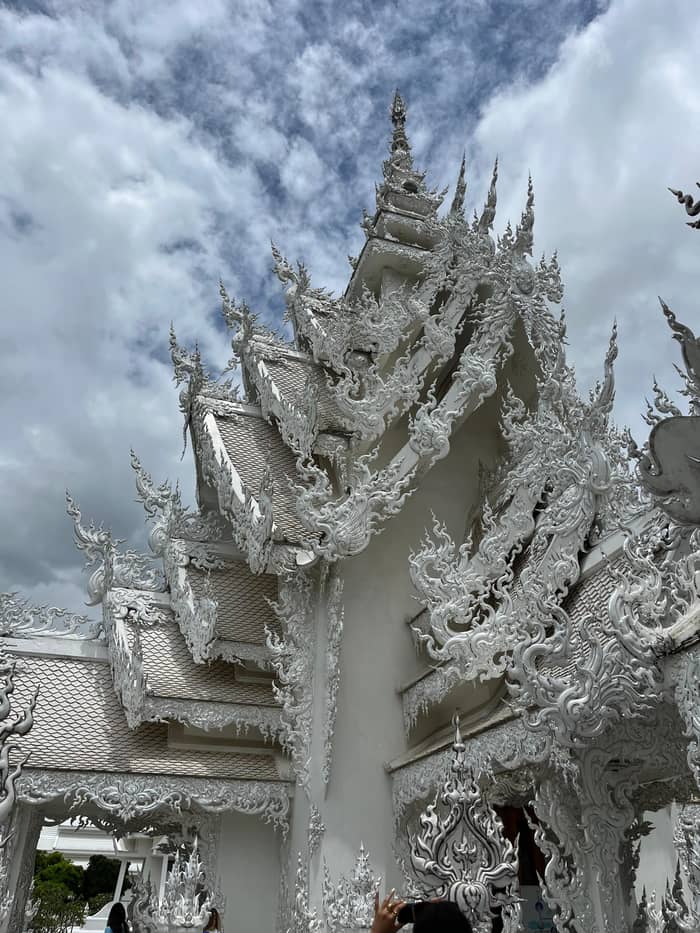
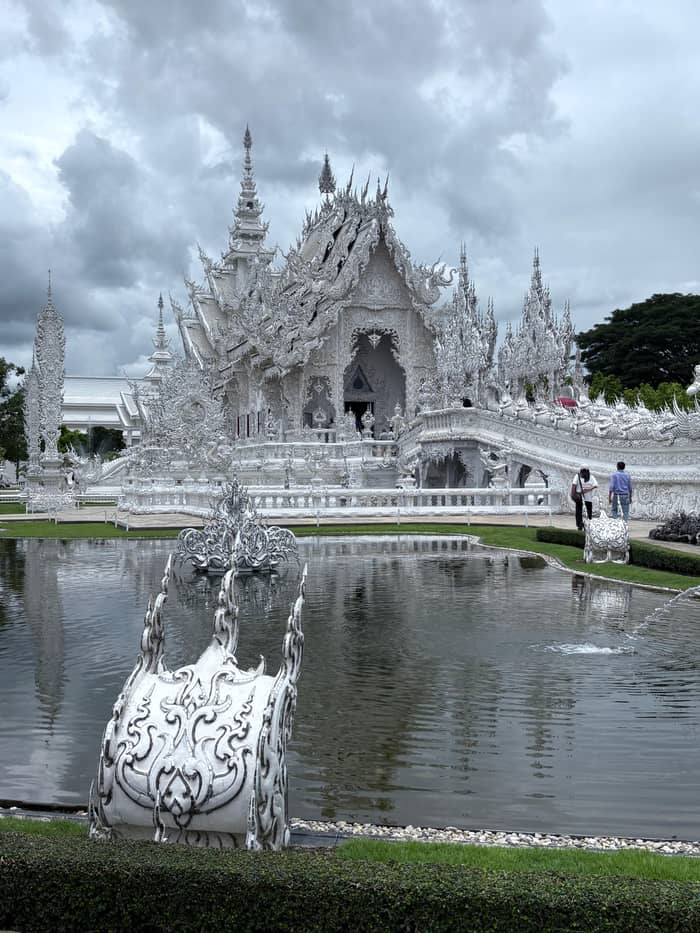
The temple is more than a facade. Visitors reach the main hall by crossing a bridge that symbolises rebirth, and the grounds hold a golden sanctuary for Ganesha and an Art Cave that took six years to craft.5,6 Outside the temple proper there are art galleries and exhibition rooms showing the artist's own work.7 Each area has a different feel, and each one asks for a different pace, so treat the visit as a short walk through several small places rather than a single hall with a queue outside, and you will remember more of it.
The official pages do not set a camera rule for the inside of the hall, so this guide does not invent one. Watch for signs at the door and follow the staff, and if a sign asks for no pictures, put the phone away. That is the standard approach in a working Thai temple, and it keeps you on the right side of the people who maintain the building every day.
Listings set aside 1 hour to 1.5 hours for the White Temple. The van and bus option lists 1 hour at the temple, while the 10-hour hot spring day and a private day list 1.5 hours. The shorter slot is enough to cross the bridge, look at the hall and use the grounds, but a longer slot lets you see the galleries without rushing.
A half-day from Chiang Rai that lists 3 temples gives the White Temple 1.5 hours, then a car of 30 minutes to the Blue Temple. If you plan to arrive by your own car, 1.5 hours is a comfortable minimum, and anyone who wants to read the murals and visit the golden Ganesha sanctuary can add more. The temple has been under construction since 1997, so the site keeps changing.20
Fill the time with a plan: the bridge and hall first, then the gardens and the Art Cave, then the galleries outside the temple. The gold lavatories behind a gleaming gold facade are worth a look too, and the tourist office says visitors should donate if they can, because work on the site is planned to continue until 2070.8,9
FAQ
The tourist office page lists 100 baht, and one tour listing tells guests to carry THB 200 for the White Temple, so bring cash for the higher figure.1
That is what the Tourism Authority of Thailand lists on its attraction page; hours can change, so check before a special trip.1
The tourist office says shorts must cover the knees, and one listing bans short pants at the temples altogether.2
Shoes come off before the temple itself, and racks wait outside, the tourist office says.4
One listing lists cash fees and another puts tickets in its title, while the coach day's record does not itemise them.
Most temples allow photographs but ask you not to block people who pray, and the official pages give no separate camera rule.16
Sources
Going north to Chiang Rai? A real person can answer here.