Coach
The coach day
Hot spring, village, 3 temples
- From$33
- Length11 to 13.5 hours
- Reviews7,712
Group price calculator
Side-by-side: 4 options
Give your party size and compare shared seats on temple days.
≈
View≈
View≈
View≈
ViewGetYourGuide's starting prices, converted at the ECB reference rate; exact pricing appears when you book.
The White Temple is a living art project, not an ancient ruin. Learn who made it, what each part shows and how to use the hour or so that a day tour gives you.
Editorial team, chiangraidaytour.click · Updated November 16, 2026 · ~8 min read
Summary view
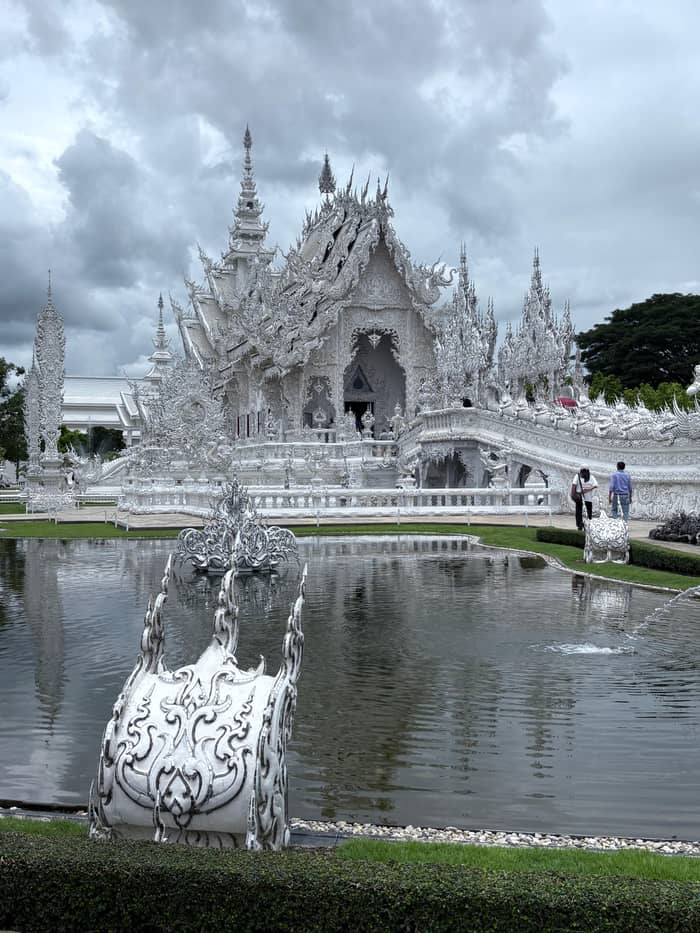
Wat Rong Khun is the formal name of the place everyone calls the White Temple. About 5 km separate it from the centre of Chiang Rai, and it is at once a Buddhist temple and a large piece of contemporary art.6 In the authority's words it is more than a temple, an open gallery of sculpture and murals.2 Think of it as a gallery you walk through on foot, with a sacred purpose at its centre.
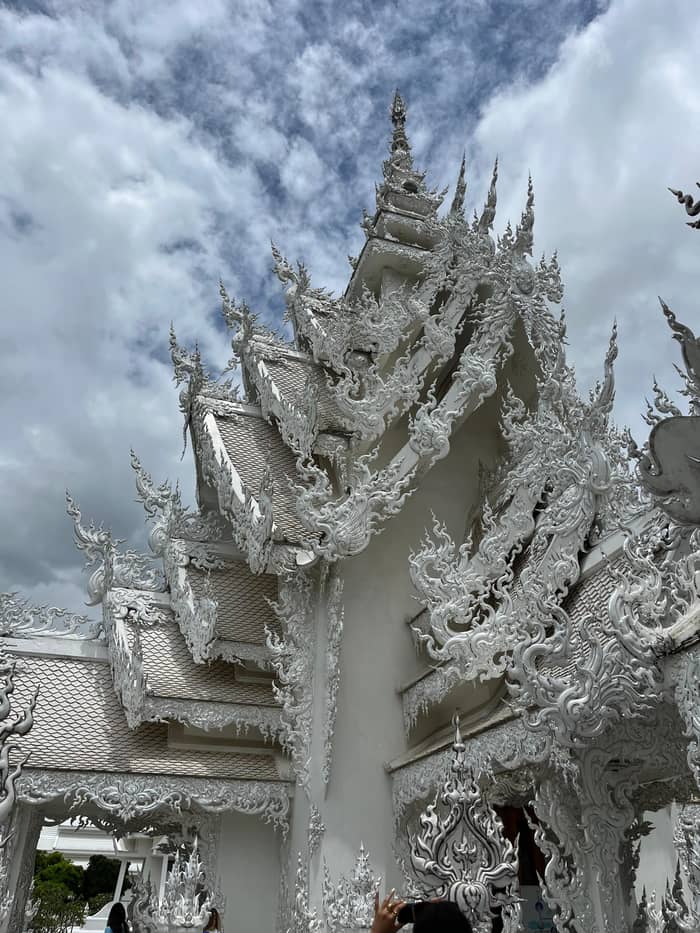
An older temple stood here before the artist arrived. Chalermchai Kositpipat took it over at the end of the 1990s, and the whole exterior now gleams in white and silver.1 That is why the place looks nothing like the temples of Chiang Mai, where gold, teak and age set the tone. Seeing it as an art project explains most of what surprises first-time visitors, and it is a useful frame to carry in through the gate.
Seeing it as an art project explains most of what surprises first-time visitors: the bold sculpture, the humour, the modern characters and the sense that the building is still being made. It asks you to look slowly, to read the details, and to accept that a temple can be contemporary and sacred at the same time.
What to look for
| Part | What it shows |
|---|---|
| The exterior | White and silver all over1 |
| The bridge | The cycle of rebirth4 |
| The main hall | Mythical creatures in carved detail4 |
| The murals | Modern figures beside demons7 |
| The big painting | The Tham Luang cave rescue6 |
| The gold building | The decorated lavatories8 |
Each row follows what the Tourism Authority of Thailand writes about Wat Rong Khun; the layout of the grounds can change as work continues.5
The Tourism Authority of Thailand calls the White Temple the creation of Chiang Rai-born Chalermchai, a national artist.3,6 He fuses elements from his own imagination with orthodox Buddhist teachings about heaven, hell, karma and earthly sins, which gives the temple its mix of reverence and invention.3 That mix is the key to reading the whole compound: every figure is both a story and a statement.
A second TAT article says he wanted the reign of King Rama IX to be marked with its own artistic style, and the temple is how he did it.9 The same artist designed the Chiang Rai Clock Tower in the city centre, so the temple and the clock tower share a hand.10 The clock tower is a useful comparison if you want to see more of his work after the temple.
Chalermchai is in no hurry to finish. The authority writes that building at Wat Rong Khun continues until 2070 and suggests a donation to the project.5 A temple still under construction has a different energy from a finished one, and it gives a return visitor a reason to look again. It is a long project, and the long view is part of how the place should be read.
Time on the day
Time at Wat Rong Khun as each listing states it: the private half day, the big bus day, a day from Chiang Rai, the 10-hour hot spring day, the private highlights and the half day from Chiang Rai.
The history has two layers. The first is the temple that existed before the artist arrived, which he took over at the end of the 1990s.1 The second is his rebuilding, which gave the compound its white and silver exterior and its sculpture and murals.1,2 It is a short history for a temple that is still being written, and the most recent chapters are the most visible.
Its recent history runs through the cultural life of the city. In 2023 the Thailand Biennale Chiang Rai used Wat Rong Khun among the main sites in the city, alongside the Baan Dam Museum.13 Chiang Rai also joined the UNESCO Creative Cities Network in 2023, as a Creative City of Design.14 Both are recognitions of the city's art and design.
The story is still being written. A visitor today sees a temple partway through a project meant to last for decades more, so a first visit shows a work in progress and a later one may show something new. Because the work continues, any account of the temple is a snapshot, and the grounds you see may differ in small ways from the ones in a photograph taken a few years ago, so treat the details on this page as pointers to look for, not a fixed plan of the site.
Plan your hour
Tell us what drew you here and see where your minutes should go.
If I came for the symbolism
Start at the bridge
The bridge represents the cycle of rebirth.4
If I came for the modern surprises
Find the murals
Spiderman and Neo stand beside demons and the Buddha.7
If I came for photographs
Choose the light
The authority praises a clear winter-blue sky.11
If I want fewer crowds
Arrive early
The temple records about 10,000 visitors per day.12
If I want to hear the story
Book a guided day
The coach day has a guide in English, from $33.
Three ways to see it
Coach
Hot spring, village, 3 temples
More time
1.5 hours at the temple
No drive
No long drive
The approach is the first lesson. The Ubosot, the main hall, is reached by crossing a bridge that stands for the cycle of rebirth.4 The building is covered in beings from Thai and Buddhist myth, which crowd the white surfaces in carved detail.4 Walking the bridge is a small act of theatre: you cross from the ordinary world into the temple.
The teaching behind the walk is the one the authority describes: orthodox Buddhist ideas about heaven, hell, karma and earthly sins, worked into the layout of the grounds.3 That is why the crossing feels like a journey and not simply an entrance. The scenes on either side of the bridge are part of the lesson, not decoration.
Take your time on the bridge and the steps. Guides are used to explaining the symbolism, and a day tour gives you a guide who can point out what to look at. If you are on your own, look slowly, ask what a figure might mean and let the sculpture do the explaining.
Your walk
The approach
You enter the main hall over a bridge that represents the cycle of rebirth.4
The hall
Creatures from Thai and Buddhist mythology decorate the building.4
The murals
Spiderman, Neo and Michael Jackson stand beside demons and images of the Buddha.7
The painting
A large painting depicts the Tham Luang cave rescue and its key figures.6
The gold building
The lavatories lie behind a gleaming gold facade and are intricately decorated.8
Your hour
Day tours give the temple 1 hour or 1.5 hours.
Popular culture is the temple's best-known surprise. The authority notes that Spiderman, Neo and Michael Jackson appear alongside demons of the Ramayana and images of the Buddha.7 Chalermchai has also used icons from modern culture, such as spaceships and Neo, to tell stories of the Buddha's life and teachings.15
The purpose is not a joke. The artist reinterprets traditional temple murals with wit and a critique of the greed and violence of today's world, and the authority likens the effect to Pop Art.2 The modern figures sit beside the traditional ones rather than replacing them. Seen from a distance the building is calm, and the detail is what rewards a closer walk.
One mural records a real event, a large painting by a team of artists led by Chalermchai that depicts the Tham Luang cave rescue and its key figures.6 It shows that the temple is a place that responds to its time. Look for it, and notice how the same hand moves between the mythical and the news.
Video
Gorov Travel on YouTube · Tap play to load the video; not before.
Not just a temple, this is also an open art gallery showing Chalermchai’s talent in sculpture and murals
At the temple
White is the temple's signature, and silver gives it sparkle. The entire exterior is white and silver.1 In full sun the surfaces glare, and under cloud they turn soft, so the same view can look very different from one hour to the next. Leave a few minutes for the approach to the bridge as well. Give the main hall your first look and the sculpture your second.
The Tourism Authority of Thailand writes that in the cool season the White Temple looks spectacular under a clear winter-blue sky, its snowy-white spires appearing as if carved from ice, while the nearby Blue Temple offers a sapphire-hued contrast.11 If you can choose your season, that is the postcard version of the visit.
Whatever the weather, the grounds reward a second lap. The first pass is for the shock, the second is for the detail. Photographers should look for reflections and for the way shadow carves the filigree on the eaves, and everyone should leave a little time to simply stand and look. Our separate page covers the entrance fee, opening hours and dress code in detail.
The day tours are tight on time. The big bus listing gives Wat Rong Khun 1 hour, a 10-hour day gives it 1.5 hours, and a private highlights day also lists 1.5 hours. A day that starts in Chiang Rai lists 1 hour, and a half day from Chiang Rai gives 1.5 hours. It is a good bridge between the long drive of the morning and the quieter temples that follow.
Plan to see the bridge, the main hall and the murals first, then use any remaining time for the grounds. The golden building that houses the temple's lavatories is a surprise of its own: the authority says the lavatories lie behind a gleaming gold facade and are intricately decorated.8 Even the practical stop is part of the art.
Expect company. Wat Rong Khun records about 10,000 visitors per day, so queues and crowded corners are normal, and an early start makes a difference.12 Our separate page covers the entrance fee, opening hours and dress code, and it is worth reading before you go so that you arrive with the right clothes and the right cash.
Most visitors reach the White Temple on a day tour from Chiang Mai, and the stop sits in the middle of the day. On the coach day sold here, a long bus leg of 2.25 hours leads to Wat Rong Khun, with optional lunch in Chiang Rai province, and the Blue Temple follows after 30 minutes on the bus. That order is the one the coach itinerary follows, and it gives you the headline sight after the first stops of the day.
The coach day starts from $33 and has a guide in English, which makes the stop easier to understand. A small group or private day gives you more control over how long you stay, and a day from Chiang Rai itself gives you the temple without the long drive. The choice depends on how much time you want and how far you want to travel to get it.
Whichever you choose, tell your guide what interests you most, whether the symbolism, the photography or the story of the artist. A good guide will use the limited time well, and a short list of questions turns a crowded hour into the part of the day you remember best. Come with questions and a willingness to look slowly.
FAQ
The authority places Wat Rong Khun about 5 km from Chiang Rai city.6
The whole exterior is a striking white and silver, as the authority describes it.1
The authority says building continues until 2070 and suggests a donation to the project.5
He has used icons such as spaceships and Neo to tell stories of the Buddha's life and teachings.15
You enter the main hall over a bridge representing the cycle of rebirth.4
The big bus listing gives it 1 hour and a 10-hour day gives it 1.5 hours.
The temple records about 10,000 visitors per day, so arrive early.12
Sources
Going north to Chiang Rai? A real person can answer here.